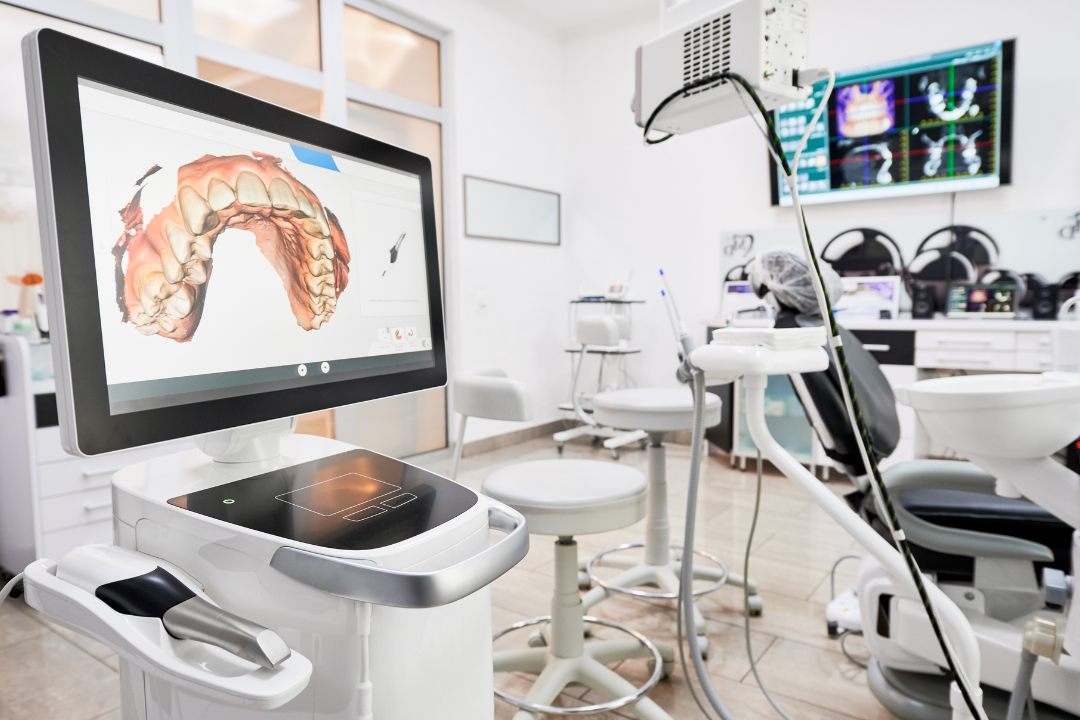
Guided surgery is marketed with an implied precision that deserves scrutiny. The evidence supports it clearly, and it does not support perfection.
What the studies report
Meta-analyses consistently show guided placement deviating less from the planned position than freehand placement. Typical mean deviations are around a millimetre or less at the implant platform, somewhat greater at the apex, with angular deviation of a few degrees.
Fully guided protocols outperform partially guided ones, which in turn outperform freehand.
What the numbers mean clinically
A deviation under a millimetre is irrelevant in a wide posterior site with bone to spare. The same deviation adjacent to a nerve, or between two natural teeth in the aesthetic zone, is not.
This is why safety margins are built into planning. The guide reduces variability; it does not license planning to the edge of the anatomy.
Where the error actually comes from
Mostly the fit of the guide, which depends on the quality of the scan it was built from and on the printing and post-curing protocol. Guides supported by teeth are more accurate than those supported by mucosa.
A guide that rocks even slightly transfers that movement directly into the drill path, and confers false confidence while doing so.
The judgement that remains
If what is encountered does not match the plan, the guide is set aside. Bone quality is assessed by feel during drilling, and no plan conveys that in advance.
Guided surgery makes a good plan reproducible. It does nothing whatsoever for a poor one.
It is a meaningful improvement in predictability rather than a guarantee of precision. Treat any clinic claiming millimetre-perfect placement as overstating what the evidence supports.
If you want to know how this would apply to your smile, book a remote consultation with us.